Integration of renewable energy, storage, and innovative solutions
Introduction
Within SILab, hybrid and experimental systems represent a research area dedicated to the development of non conventional energy architectures, designed to overcome the limitations of traditional production and storage systems. The objective is to explore solutions capable of increasing energy resilience, improving power flow management, and reducing reliance on single technologies through a modular and integrated approach.
Design vision
The research is based on a systemic vision of energy, where production, storage, and utilization are considered parts of a single technical ecosystem. Systems are conceived to operate autonomously or semi-autonomously, to adapt to real and constrained environments, and to be scalable and reconfigurable over time.
Hybrid system architecture
The developed Architectures combine MULTIPLE ENERGY STORAGE and MANAGEMENT TECHNOLOGIES, integrating renewable generation, conventional electrical storage, and experimental mechanical solutions. This integration makes it possible to separate and optimize different system functions, such as fast response, short-term storage, and load management.
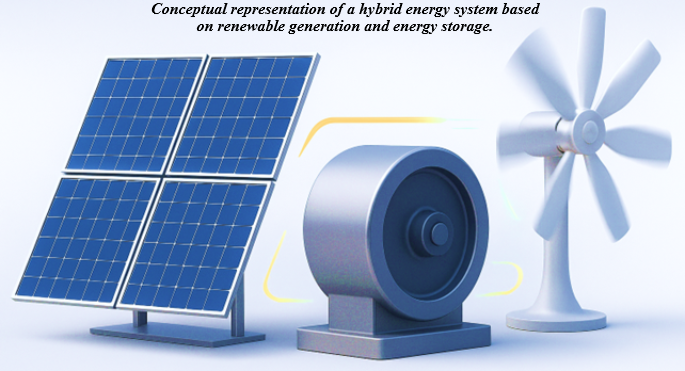
Mechanical flywheel energy storage
One of the main research areas concerns mechanical ENERGY STORAGE through FLYWHEEL Systems, based on the conversion of electrical energy into rotational kinetic energy.
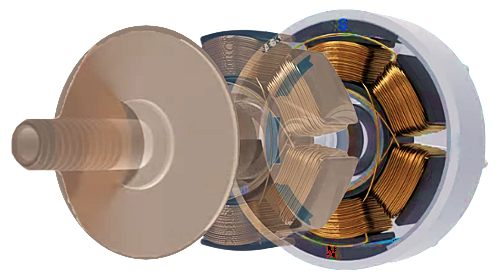
Flywheels are studied as elements for power flow stabilization and as support systems for conventional electrical storage, offering high cycling capability and long operational life.
Integration with photovoltaics
Flywheel-based systems are analyzed in hybrid configurations where photovoltaic generation provides primary energy production, while mechanical storage contributes to dynamic energy management.
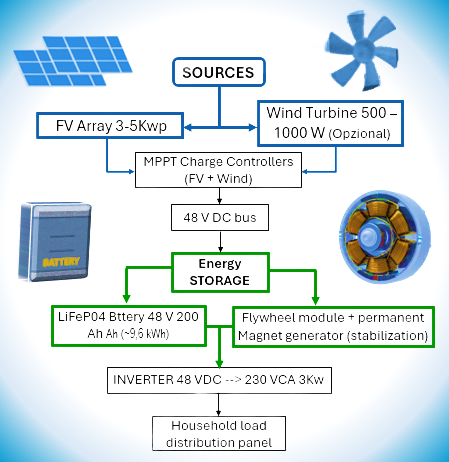
This integration allows rapid absorption of production peaks, reduced stress on batteries, and improved overall system stability.
Development status
Current activities focus on defining system architectures, conceptual module design, development of experimental prototypes, and performance analysis. The development process is incremental and documented, with the aim of transforming research into technically validated solutions.