Introduction
Low-enthalpy geothermal energy represents an area of study of particular interest for Silver Innovation Lab, as it allows the exploration of energy solutions based on thermal exchange with the subsoil, characterized by continuity, stability, and reduced environmental impact. Unlike other more widespread energy sources, geothermal energy makes it possible to reason in terms of passive systems, natural thermal storage, and integration with hybrid energy architectures, without the need for large infrastructures or intensive exploitation of resources. SIL’s activity in this field is oriented toward the conceptual study of physical principles, thermal exchange configurations, and potential integrations with experimental mechanical and energy systems, while maintaining a prudent, analytical, and progressive approach.
Approach to Geothermal Energy
Silver Innovation Lab’s approach to the study of low-enthalpy geothermal energy is analytical and systemic, focused on understanding physical principles and thermal exchange dynamics rather than on the immediate implementation of applied solutions. The primary interest lies in the mechanisms of heat transfer between the subsoil, structures, and mechanical systems, with the aim of evaluating simple, scalable configurations that can potentially be integrated into hybrid energy architectures. In this context, geothermal energy is regarded as a stable and continuous thermal resource, useful for exploring concepts such as natural thermal storage, reduction of energy fluctuations, and passive support for other energy production and management systems. Research activities are developed through conceptual studies, functional schemes, and principle-based models, while maintaining a prudent and progressive approach consistent with the experimental and research-oriented nature of SIL.
Thermal Exchange and Passive Systems
The study of thermal exchange with the subsoil represents one of the central aspects of Silver Innovation Lab’s approach to low-enthalpy geothermal energy. At depths approximately between 15 and 30 meters, ground temperature tends to remain nearly constant throughout the year, with average values in the range of 14–17 °C, being only marginally influenced by seasonal variations and surface climatic conditions. This thermal stability makes the subsoil a resource particularly suitable for the exploration of passive heat exchange systems, in which the objective is not the extraction of high-temperature energy, but rather the efficient management of thermal flows through limited and time-stable temperature differences.
Subsoil temperature at different depths
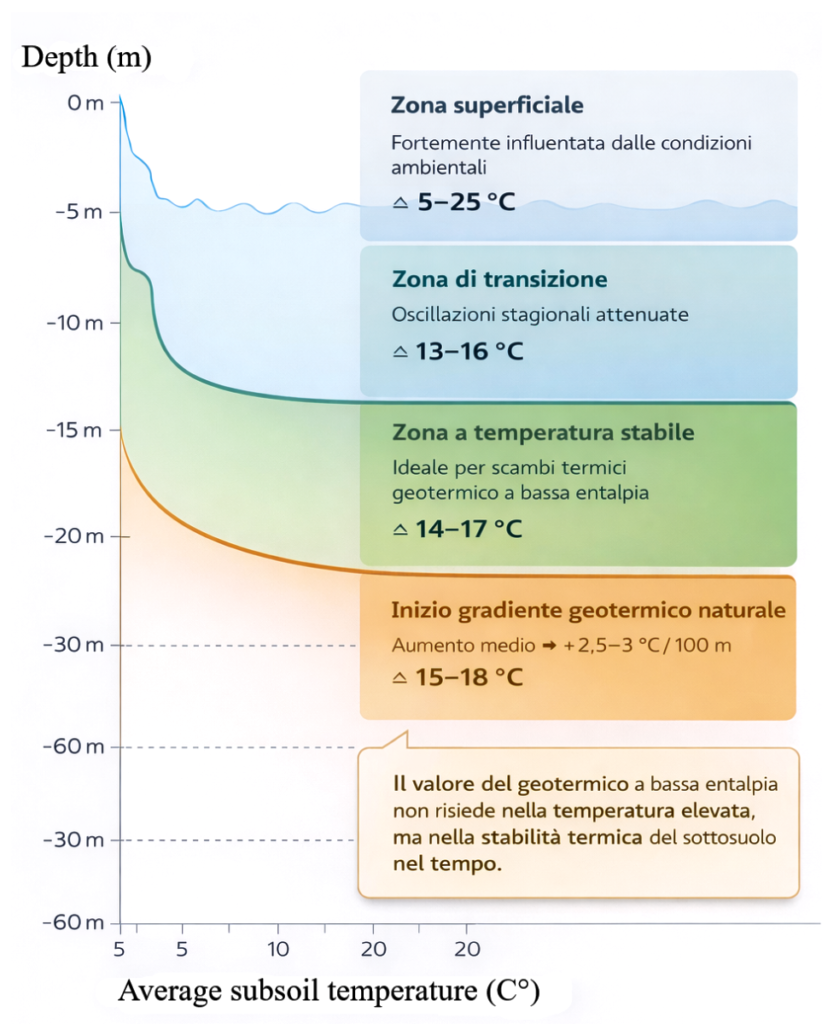
Indicative trend of subsoil temperature as a function of depth. Actual values depend on geological and climatic conditions.
At greater depths, starting approximately from 30–60 meters, the onset of the natural geothermal gradient can be observed, characterized by a slow and progressive increase in temperature, averaging about 2.5–3 °C per 100 meters. In this case as well, the primary interest lies in the continuity and predictability of the thermal resource, rather than in the absolute temperature value. Within this framework, SIL considers low-enthalpy geothermal systems as passive and support elements, potentially integrable into hybrid energy architectures, aimed at reducing thermal fluctuations, improving overall system efficiency, and studying simple, scalable, and low-impact solutions.
Integration with Hybrid Energy Systems
The integration of low-enthalpy geothermal systems with hybrid energy architectures represents an area of particular interest for Silver Innovation Lab, as it enables the enhancement of thermal exchange with the subsoil within broader and more flexible energy systems. In this context, geothermal energy is regarde as a stable and continuous thermal source, usable in combination with other technologies for energy self-production and management, uch as photovoltaic systems, electrical energy storage, and intelligent energy flow management solutions. The hybrid approach makes it possible to: 1) reduce dependence on intermittent energy, sources, 2) improve the operational continuity of systems, 3) optimize the use of locally produced energy, 4) increase the overall efficiency of the energy architecture. The configurations studied by SIL are oriented toward modular and scalable systems, in which the geothermal contribution can be adapted to environmental conditions, application requirements, and system constraints, while maintaining an experimental and progressive framework. The integration with hybrid energy systems is therefore analyzed as a strategic support element for stability, energy autonomy, and the technical sustainability of the systems developed.
Geothermal without HP
Limits and feasibility of using low-enthalpy geothermal systems without the adoption of a heat pump (HP).
Geothermal with HP
Operating conditions and minimum requirements for integrating a low-enthalpy geothermal system with a heat pump (HP).
Geothermal with Hybrid Energy Sistems
The integration of low-enthalpy geothermal systems with hybrid energy architectures represents an area of particular interest for SIL, as it allows thermal exchange with the subsoil to be effectively leveraged within broader and more flexible energy systems.